Happy Four Year Farmiversary to Robin!
As of this week, Robin has been working in the farm for a full four years. He has become such an important part of our farm operation that it’s hard to remember how we managed before he was here. Although he does many things on the farm, he specializes in washing and packing, handling almost all the produce we harvest. No one could ask for a steadier, more reliable employee than Robin. Hot or cold, rain or shine, we can always count on him, and we are incredibly grateful to have him as a member of our team.
Green Beans and Meditations on Waste
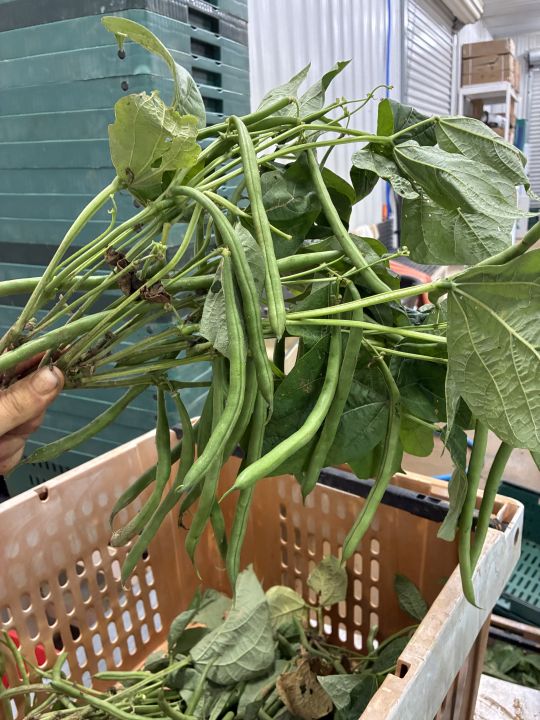
I posted a video on social media showing how we cut the whole plant when we harvest our green beans, and bring them into the wash pack to pull the beans off. I was surprised to get a lot of negative feedback from people insisting this was wasteful and lazy, because the beans would continue to produce if left in the field.
They are correct, the beans will continue to produce in the field and could be picked multiple times, which would result in more beans. In fact, we have tried harvesting them this way in the past. The problem is that beans picking is incredibly time consuming. The beans themselves are easy to grow, the work is in getting them off the plant. In the past, with field picking, we never could get the whole job done. The work was hard, slow, and hot. At this time of the year, when the beans are ready, they are many other demands on our time. Time will always be the most limiting resource on the farm. We actually stopped growing spring beans for many years because of this. It was only after I learned about the single harvest method did we try spring beans again last year.
Despite the fact that beans left in the field could produce more beans, what we have found with our first hand experience is that we actually get more beans harvested when we pick the whole plant. Even when we cut the whole plant, picking beans is a slow job. But at least it doesn’t have to be done bent over in the heat. I am grateful for that, and our employees are, too.
But it got me thinking about waste and wastefulness. No one wants to be called wasteful. We put a lot of thought into reducing waste. What exactly is wasted when we harvest the whole bean plant? I suppose it is the potential of that plant to produce more food. Yes, we want to maximize what a plant produces, but only to the extent that we can economically harvest and sell that produce. This is, after all, a business. I love what I do, but it has to be profitable in order for me to earn the privilege of farming.
Yes, It is painful to see “wasted” crops get tilled in. The carrots we couldn’t get harvested before they started to rot in the ground in the winter. The cabbage that I know we wont be able to sell even if we picked it. The edamame soybeans that got overwhelmed by the weeds and are beyond saving. I see the wasted potential harvest, and I also the wasted resources that when into growing that crop.
But I am comforted by the fact that there is no waste in nature. Failed crops and successful crops alike get turned into the ground to feed the soil food web. It all decomposes and becomes something new and feeds countless lives in between. Maybe that crop didn’t feed a human or contribute to our bottom line, but it fed something. Many somethings. Which is such an important thing to do that we actually grow crops specifically for this purpose – cover crops. If the occasional cash crop turns into a cover crop, what’s so bad about that? As a business owner I have gotten better at not throwing good money after bad, and knowing when to pull the plug.
I guess my point is that in the realities of farming, we have more to consider than just how much we can get a plant to produce. We have to consider whether or not it is “worth it” economically to harvest a crop. If it takes too much labor, we find ourselves selling crops at a loss. But even when a crop gets tilled in, nothing is wasted. Nature invented nutrient cycling. Everything is regenerated.
Small Shares
- savoy cabbage
- carrots
- yellow onions*
- squash or zucchini
- heirloom tomatoes
Full Shares
- savoy cabbage
- carrots
- yellow onions*
- squash and zucchini
- heirloom tomatoes
- green beans
*the onions have not been cured, please store in the refrigerator or leave on the counter to cure


You must be logged in to post a comment.