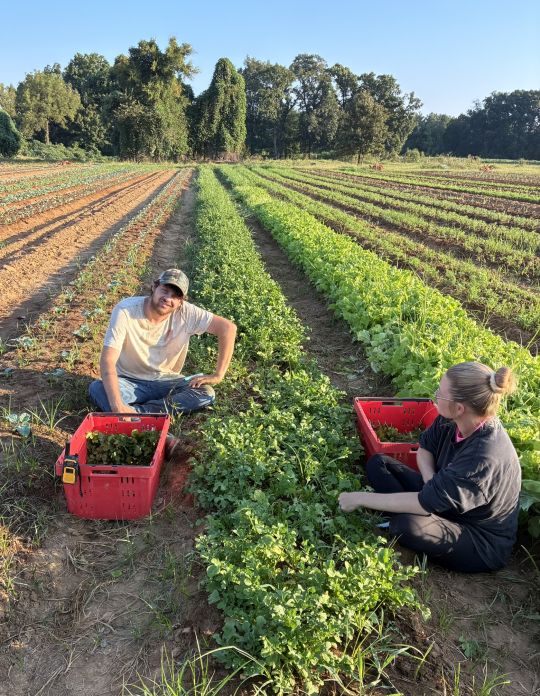
I love salad
I hope you are as excited about salad as I am! This week the box features multiple salad greens. Tokyo Bekana is the pale green leaves in your box. It’s a great substitute for lettuce that we can grow in hotter weather than lettuce will tolerate. It is mild, crunchy, and (in my opinion) best eaten raw. Because it’s been so hot the arugula is very spicy. It is probably best to mix it with another green or give it a quick sauté unless you really like a pepper bite. Likewise, the radishes are hot. We were hoping for some cooler nights before harvesting these, but the weather has been that. You can sauté the radishes and throw in their greens at the last moment, or they’re also delicious roasted. If you eat them raw, be prepared for a hot radish.
Full shares are also getting Komatsuna. Komatsuna is a thicker, darker green leaf with a mild flavor similar to bok choy. It makes an excellent spinach substitute and grows in weather that spinach will not tolerate. It can be enjoyed raw or cooked. Like spinach, it cooks quickly.
How do we keep it all watered?
At this time of the year, I am grateful for a functioning irrigation system. We had an incredibly dry August with less than half an inch of rainfall over the whole month. August is the driest month, but we usually get around 3 inches. You might be wondering how we keep our crops watered in this heat. When we bought our farm, one of the first things we did was dig a well. This well provides all our irrigation water, and also the water we use in the wash/pack and even my mom‘s tiny house. Buried pipes take the water to the crop field where we then run orchard tubing above the ground.
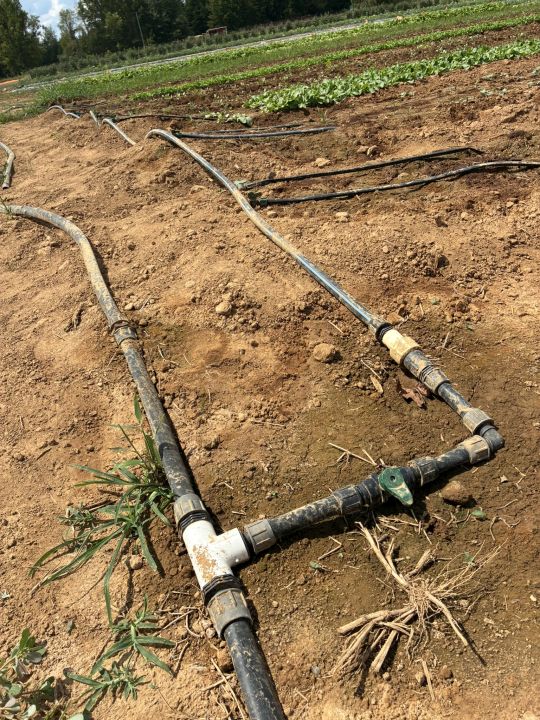
The garden beds themselves are fed with drip tape. Drip tape is a flat plastic hose with emitters every 8 inches that weep when the hose is inflated with water. We make our garden beds with a tractor implement called, surprisingly enough, a bed shaper. We mount rolls of drip tape on the bed shaper, which feeds them along the ground as the implement piles and smooths the soil over them. The end result is two lines of drip tape two or three inches below the surface in each bed. The field is divided up into zones that each contain around five 180 foot beds. Each of these zones has a shut off valve so we can deliver water to the garden as needed.
Burying the drip tape has several advantages. First, it delivers water right where it’s needed – the roots of the plants. Less water is lost through evaporation at the surface, making the system very efficient. Equally important is that burying the tape protects it from rodents and other animals. Rodents like to gnaw on the tape in search of water, making little pin holes that turn into fountains or geysers throughout the field. We fix these with electrical tape.
The main downtown side to this system is the plastic waste it produces. Unfortunately we are not able to recycle the drip tape and it is thrown away at the end of each season. Because of this, we only put down drip tape when we know we will need to water numerous times. Lately we have been running water every day to some part of the garden or other.
Irrigation is necessary in this weather, but it is not a replacement for rain. We need rain to water the pasture, to germinate our cover crop, to help crop residues break down, and to add moisture to the soil so that we can prepare beds for spring. We’re a little behind schedule because it’s been too dry to do some of the work that we usually have done by now. The weeks ahead look pretty dry too, but we know the rain will come eventually.
Small Shares
- Tokyo Bekana
- Arugula
- Butternut Squash
- Yellow Squash and/or Zucchini
- Radishes
Full Shares
- Tokyo Bekana
- Arugula
- Komatsuna
- Butternut Squash
- Mini Watermelon
- Radishes


You must be logged in to post a comment.